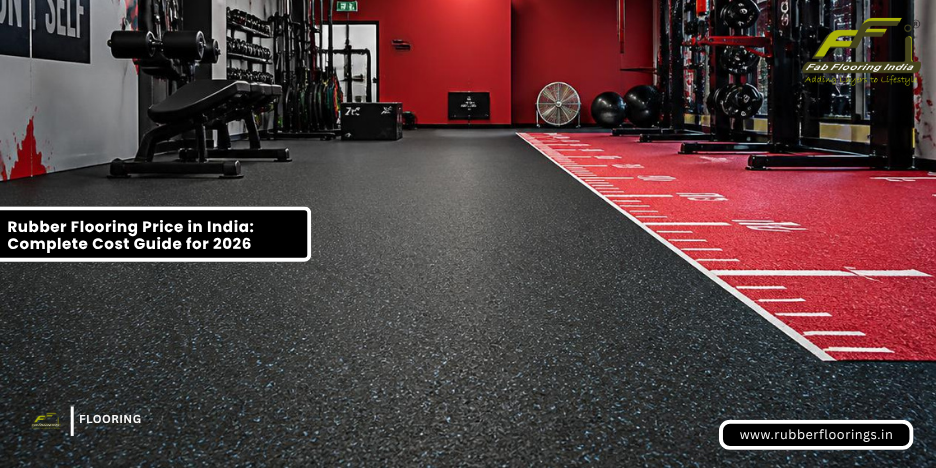
Rubber Flooring Price in India: Complete Cost Guide for 2026
If you are planning a gym, home workout area, commercial fitness centre, playground, garage, or industrial space, rubber flooring price in India can vary significantly depending on thickness, material, format, density, finish, and installation.
For 2026, indicative market listings show rubber flooring ranging from roughly ?50–?400+ per sq. ft., with standard recycled SBR tiles generally at the lower end and premium EPDM or heavy-duty systems at the higher end. Actual pricing depends on specifications, quantity, location, GST, transportation, and installation.
Rubber Flooring Price in India Per Sq. Ft.
The easiest way to compare quotations is to calculate the rubber flooring cost per sq ft.
For standard recycled SBR flooring, current listings commonly fall around the lower end of the market. Premium coloured EPDM, heavy-duty tiles, and specialised flooring systems can cost substantially more.
A practical 2026 budgeting range is:
- Basic rubber tiles: ?50–?100/sq. ft.
- Medium-duty rubber tiles: ?80–?150/sq. ft.
- Rubber rolls: ?80–?200+/sq. ft.
- Heavy-duty rubber flooring: ?150–?300+
- Premium EPDM flooring: ?175–?400+
The final rubber flooring price should always be confirmed against the exact thickness, density, composition, dimensions, colour, quantity, and installation specification.
What Determines Rubber Flooring Cost in India?
1. Thickness
Thickness has a direct impact on material consumption and performance.
A 10 mm tile can work well for general gym areas, cardio zones, and lighter training. For free weights and areas exposed to repeated impact, 15–20 mm or heavier products may make more sense.
2. Rubber Material
Most economical gym flooring uses recycled SBR rubber, often produced from recycled tyre rubber.
EPDM flooring generally costs more, particularly when you choose coloured or premium-grade material. Some products also combine SBR with EPDM flecks to achieve a balance between performance and appearance.
3. Tiles vs Rolls
Rubber tiles are easier to replace individually. If one section becomes damaged, you don't necessarily have to replace the entire floor.
Rubber rolls provide fewer seams and can be more efficient for large, open areas. However, cutting, positioning, joining and installation can require more planning.
4. Density
Two products can have the same thickness but perform differently because of their density and construction.
For heavy gym equipment, don't evaluate flooring by thickness alone. Ask the supplier for density, hardness, tensile properties, intended application and impact performance.
5. Colour and EPDM Content
Black recycled rubber is typically more economical.
Adding coloured EPDM flecks or choosing a fully coloured premium surface can increase the rubber flooring price.
6. Quantity
Commercial projects can have minimum order quantities and volume-based quotations.
For example, some current supplier listings specify MOQs ranging from hundreds of square feet upward, so a commercial quotation may differ considerably from a small retail purchase.
Gym Rubber Flooring Price: Tiles vs Rolls
Choosing between tiles and rolls depends more on your application than on price alone.
Rubber Tiles
Pros
- Easy individual replacement
- Convenient for irregular areas
- Suitable for home and commercial gyms
- Good option for heavy-equipment zones
- Installation can be relatively straightforward
Cons
- More seams
- Edges can move if the installation is poor
- Dirt can accumulate around poorly joined sections
Best choice: Weight areas, home gyms, CrossFit zones and spaces where future repairs are important.
Rubber Rolls
Pros
- Fewer visible seams
- Clean appearance
- Excellent for large open areas
- Efficient for commercial gym layouts
Cons
- More difficult to handle
- Cutting errors can waste material
- Installation requires greater precision
- Individual damaged sections aren't as easy to replace
Best choice: Large fitness centres, training studios and commercial spaces.
Rubber Floor Mats Price in India
Rubber floor mats are another popular option when you don't need wall-to-wall flooring.
Current listings show products at different thicknesses and specifications. For example, a 20 mm recycled rubber gym mat is currently listed at ?95/sq. ft. by one Indian manufacturer, while other suppliers list basic gym mats and SBR tiles at lower rates.
For a quotation, compare:
- Mat thickness
- Dimensions
- Weight per mat
- Rubber composition
- Density
- Surface texture
- Edge design
- Anti-slip performance
- Warranty
- MOQ
- Delivery charges
How Much Does Rubber Flooring Cost for a Gym?
Let's use a simple example.
Suppose your gym has 1,000 sq. ft. of flooring area.
If the material costs ?80/sq. ft.:
1,000 × ?80 = ?80,000
At ?150/sq. ft.:
1,000 × ?150 = ?1,50,000
At ?250/sq. ft.:
1,000 × ?250 = ?2,50,000
This is the material calculation only. Installation, adhesive where applicable, floor preparation, transportation, wastage, GST and other project costs can increase the final budget.
For glue-down systems, installation and adhesive can add a meaningful amount to the material price; interlocking or loose-lay products can reduce or eliminate some installation costs.
Key Takeaway: Always ask for a complete project quotation rather than comparing only the advertised ?/sq. ft. rate.
Rubber Gym Flooring Cost by Application
Home Gym
For a home gym, 8–15 mm rubber flooring can be sufficient for many general workout applications.
If you're regularly dropping heavy barbells, consider thicker flooring or a dedicated impact zone.
Commercial Gym
Commercial gyms usually need better durability because the flooring experiences much higher daily traffic.
A 15–20 mm rubber tile or roll system can be a practical starting point, with thicker flooring in heavy lifting zones.
Weightlifting Area
This is where buying too cheaply can backfire.
For deadlift platforms and repeated weight drops, consider 20 mm+ heavy-duty rubber flooring, particularly in designated impact zones.
Kids' Play Areas
Safety, impact absorption, slip resistance, drainage and outdoor durability become more important than simply finding the lowest price.
EPDM systems are frequently used where colour, outdoor exposure and playground performance matter. Current Indian market guides place installed EPDM systems broadly above basic recycled rubber flooring, depending on the specification and base construction.
What to Check Before Buying Rubber Flooring
Don't request a quotation with only the words "rubber flooring."
Give the supplier these details:
- Total floor area
- Application
- Required thickness
- Tile or roll preference
- Colour
- Expected load
- Indoor or outdoor installation
- Existing floor condition
- Installation requirement
- Delivery location
Then request an itemised quotation.
This makes it much easier to compare two suppliers fairly.
Common Buying Mistakes
Choosing Only on Price
The lowest rubber flooring price in India isn't automatically the best value.
A flooring product should match your expected load, traffic, impact level and environment.
Ignoring Floor Preparation
Even high-quality rubber flooring can perform poorly over an unsuitable or uneven substrate.
Check the base before ordering large quantities.
Buying the Wrong Thickness
A 10 mm product may be perfectly adequate for one application and completely unsuitable for another.
Match thickness to the actual use rather than copying another gym's specification.
Forgetting Wastage
Always account for cutting and installation waste, especially around columns, walls, corners and equipment bases.
Not Checking the Complete Landed Cost
The quoted material price may exclude GST, transportation, adhesive, installation or floor preparation.
Your comparison should be based on the final delivered and installed cost.
Our Practical Evaluation Criteria
When assessing rubber flooring for a buying decision, these are the criteria that matter most:
- Impact resistance: How well does the floor handle repeated loads?
- Slip resistance: Does the surface provide reliable traction?
- Recovery: Does the material recover after compression?
- Dimensional stability: Does it remain stable after installation?
- Seam quality: Are tile or roll joints secure?
- Odour: Is the recycled rubber smell acceptable for the intended space?
- Cleaning: Can sweat, dust and dirt be removed easily?
- Maintenance: Can damaged sections be replaced without major disruption?
- Surface wear: How well should it withstand expected traffic?
- Installation: Is DIY installation realistic, or is professional installation preferable?
Rather than claiming laboratory or personal multi-week testing where no controlled test data is available, these criteria should be used to evaluate supplier samples and specifications before making a purchase.
Pros and Cons of Rubber Flooring
Pros
- Excellent impact protection
- Good slip resistance
- Durable for demanding environments
- Helps reduce equipment noise
- Available in tiles, rolls and mats
- Easy-to-maintain surface
- Suitable for gyms and many commercial applications
- Recycled options can make use of recovered rubber
Cons
- Premium options can be expensive
- Recycled rubber can have a noticeable odour
- Heavy tiles can be difficult to handle
- Poor installation can create gaps or movement
- Some products require floor preparation
- Outdoor applications need appropriate material specifications
Final Verdict: Which Rubber Flooring Should You Buy?
If your priority is value for money, recycled SBR rubber tiles around the 10–15 mm range are a strong starting point for general gym applications.
For heavy lifting, spend more on thicker, denser flooring rather than trying to minimise the initial rubber gym flooring cost.
For large commercial gyms, rubber rolls can provide a cleaner, more continuous installation. For premium aesthetics or outdoor/play applications, EPDM becomes more attractive.
The smartest purchase isn't the product with the lowest rubber flooring price in India. It's the flooring that provides the right combination of thickness, density, durability, installation method and total installed cost for your application.
People Also Ask
What is the average rubber flooring price in India?
A practical 2026 market range is approximately ?50–?400+ per sq. ft., depending on material, thickness, density, format and application. Standard recycled SBR products generally sit toward the lower end, while premium EPDM and heavy-duty systems cost more.
What is the rubber flooring price per sq ft for a gym?
Basic gym rubber tiles can start around ?50–?100/sq. ft., while thicker tiles, rolls and heavy-duty flooring can reach ?150–?300+ per sq. ft. Premium EPDM products can cost more.
Is rubber flooring better than PVC for a gym?
For free weights and impact-heavy training, rubber is generally the more natural choice because of its impact resistance and durability. PVC can make sense where design, hygiene, rolling equipment or specific sports applications are higher priorities.
How do I calculate rubber flooring cost?
Multiply your floor area by the material price per sq. ft., then add applicable installation, adhesive, floor preparation, transportation, wastage and taxes.