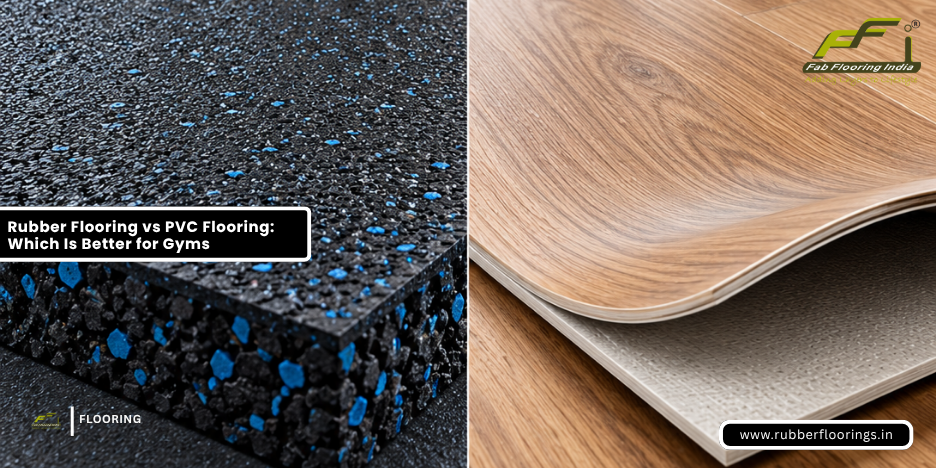
Rubber Flooring vs PVC Flooring: Which Is Better for Gyms?
Choosing between rubber flooring vs PVC flooring is an important decision when setting up or upgrading a gym. The right surface needs to handle repeated impact, heavy equipment, foot traffic, moisture, cleaning, and daily wear without becoming a maintenance headache.
Both materials can work well, but they serve different gym environments. Rubber is generally associated with impact protection, traction, and heavy-duty use, while PVC offers design flexibility, easy maintenance, and practical performance for many fitness spaces.
Quick Recommendations: Which Gym Flooring Should You Choose?
|
Buying Factor |
Rubber Flooring |
PVC Flooring |
Recommendation |
|
Heavy weights & free weights |
Excellent |
Good |
Rubber |
|
Shock absorption |
Excellent |
Good |
Rubber |
|
High-impact workouts |
Excellent |
Good |
Rubber |
|
Cardio areas |
Excellent |
Excellent |
Both |
|
Group fitness |
Excellent |
Excellent |
Both |
|
Easy cleaning |
Good |
Excellent |
PVC |
|
Heavy commercial traffic |
Excellent |
Good–Excellent |
Depends on grade |
|
Equipment stability |
Excellent |
Good |
Rubber |
|
Design options |
Good |
Excellent |
PVC |
|
Sound and vibration control |
Excellent |
Moderate–Good |
Rubber |
|
Home gyms |
Excellent |
Good |
Depends on use |
|
Overall for heavy-duty gyms |
Excellent |
Good |
Rubber |
Pro Tip: Don't choose gym flooring only by price per square foot. Compare thickness, density, surface finish, installation method, expected load, and the type of workouts performed in the space.
Rubber Flooring vs PVC Flooring: What's the Difference?
What Is Rubber Gym Flooring?
Rubber gym flooring is manufactured from rubber compounds and is available in tiles, rolls, mats, and interlocking formats. Recycled rubber is commonly used for heavy-duty applications, while EPDM-based surfaces can provide additional colour and design options.
Rubber is particularly useful where the floor must withstand dropped weights, repeated impact, vibration, and intense foot traffic.
Common applications include weight rooms, strength-training zones, functional training areas, commercial gyms, CrossFit-style spaces, and home gyms with free weights.
What Is PVC Gym Flooring?
PVC gym flooring uses polyvinyl chloride as its primary material and is available in tiles, rolls, and interlocking systems. Depending on the construction, PVC flooring can provide a durable, water-resistant, easy-to-clean surface.
PVC is often considered for cardio zones, group exercise studios, multipurpose fitness rooms, and commercial spaces where appearance and easy maintenance are important.
The important point is that not every PVC floor has the same construction. Thickness, wear layer, backing, texture, and installation system can significantly affect performance.
Which Is Better for Heavy Weights?
For areas containing dumbbells, barbells, weight plates, racks, and strength equipment, rubber flooring for gym applications generally has the advantage.
Its resilience helps it handle repeated impact and provides a protective layer between gym equipment and the subfloor. Thick rubber tiles or rolls can also help reduce vibration and impact noise.
PVC can be suitable for equipment zones when the product is specifically designed for heavy commercial use. However, using a lightweight PVC product in a serious free-weight area can increase the risk of surface damage, indentation, or premature wear.
Best choice: Rubber flooring.
Which Provides Better Shock Absorption?
Shock absorption is one of the biggest reasons gym owners choose rubber.
A properly selected rubber floor can absorb part of the impact generated during jumping, running, functional training, and weight training. Thickness and density matter, so a thin rubber mat should not automatically be treated as equivalent to a thick commercial rubber tile.
PVC can provide cushioning depending on its construction, but it is not automatically designed for the same level of impact protection as heavy-duty rubber flooring.
Best choice for high-impact and weight-training areas: Rubber.
Rubber Tiles vs PVC Tiles: Which Should You Buy?
The rubber tiles vs PVC tiles decision depends heavily on the room's purpose.
Rubber Tiles
Rubber tiles are a practical option for strength areas because individual damaged sections can often be replaced without removing the entire floor.
Interlocking rubber tiles can also simplify installation and may be useful in spaces where permanent adhesive installation is not preferred.
Pros:
- Excellent impact resistance
- Good traction
- Suitable for heavy equipment
- Strong vibration control
- Individual tiles can be replaceable
- Available in different thicknesses
Cons:
- Heavier than many PVC options
- Rubber odour can be noticeable in some new products
- Appearance can be less decorative
- Higher-grade rubber can cost more initially
Potential failure point: Choosing an undersized or low-density tile for heavy free-weight training can result in faster wear and inadequate impact protection.
PVC Tiles
PVC tiles can offer a clean, modern appearance with a wide range of colours and patterns.
They can be easier to handle than heavy rubber products and are suitable for many general-purpose gym areas.
Pros:
- Easy to clean
- Wide design range
- Water-resistant surface
- Practical for multipurpose areas
- Generally easy to install
- Suitable for cardio and group fitness areas
Cons:
- Product quality varies significantly
- Some thinner products may dent under concentrated loads
- Not every PVC product is suitable for dropped weights
- Seams and installation quality can affect long-term performance
Potential failure point: Selecting decorative or lightweight PVC flooring for a heavy weight-training zone can lead to indentation or surface damage.
Which Is Easier to Clean and Maintain?
PVC has an advantage when simple day-to-day cleaning is the priority.
Its smooth, non-porous surface can generally be cleaned with routine gym-floor cleaning methods. This makes PVC attractive for cardio rooms, studios, and areas where sweat and frequent cleaning are major concerns.
Rubber is also relatively easy to maintain, but textured surfaces can collect more dirt than smooth PVC. Rubber should be cleaned using products compatible with the manufacturer's recommendations.
Key Takeaway: Cleaning performance depends on the surface texture and product construction, not just whether the floor is rubber or PVC.
Which Is Better for Commercial Gyms?
For a commercial gym, the best flooring strategy may be a combination of materials rather than using one product throughout the building.
Use heavy-duty rubber in:
- Free-weight areas
- Squat racks
- Deadlift zones
- Functional training areas
- Heavy equipment zones
PVC can be considered for:
- Cardio areas
- Group exercise rooms
- Multipurpose studios
- Low-impact training areas
- Areas where design flexibility is important
This approach allows the flooring specification to match the activity instead of forcing one material to perform every job.
How Thickness Affects Gym Flooring Performance
Thickness should be selected according to the activity and load.
For example, a light exercise area may not require the same flooring specification as a deadlift zone. Heavy equipment and repeated weight drops generally justify a more robust rubber solution.
When comparing gym flooring options, don't ask only, "How many millimetres is it?"
Also consider:
- Material density
- Surface hardness
- Product construction
- Equipment load
- Impact frequency
- Subfloor condition
- Installation method
- Expected traffic
- Manufacturer's recommended application
A thicker product is not automatically the best product. The overall construction needs to match the intended use.
Rubber Flooring vs PVC Flooring: Testing Criteria Buyers Should Use
Before purchasing, evaluate flooring using practical criteria rather than appearance alone.
1. Impact Resistance
Consider how the flooring performs when weights, equipment, or users repeatedly impact the surface.
2. Load Distribution
Check whether the product is designed to support concentrated loads from racks, machines, benches, and other gym equipment.
3. Slip Resistance
The surface should provide reliable traction during workouts, particularly in areas exposed to sweat or moisture.
4. Noise and Vibration
For gyms located above offices, apartments, or other occupied areas, vibration and impact noise should be important purchasing criteria.
5. Cleaning
Check whether the surface can tolerate the cleaning routine required by your facility.
6. Installation
Compare interlocking, loose-lay, adhesive, and roll-based installation systems. Installation quality can directly affect long-term performance.
7. Wear Resistance
High-traffic commercial gyms require flooring that can withstand repeated use without excessive surface deterioration.
Common Buying Mistakes to Avoid
Choosing Only by Price
The cheapest flooring may not provide the durability required for a commercial gym. Replacement, repairs, and installation costs can make an initially cheap floor more expensive over time.
Using the Same Flooring Everywhere
A deadlift platform and a yoga studio have completely different flooring requirements.
Ignoring Subfloor Preparation
Uneven or damaged subfloors can create problems regardless of whether you choose rubber or PVC.
Selecting Thickness Without Considering Density
Thickness alone does not tell you everything about flooring performance. Ask the supplier about product construction and intended application.
Buying Without Checking Samples
Colour, texture, odour, surface finish, and actual feel can be difficult to judge from product photographs.
Pro Tip: Ask the supplier for a physical sample and product specifications before placing a large commercial order. If possible, test the sample under the type of equipment and workout conditions it will actually experience.
Best Flooring for Gym Areas: A Practical Breakdown
|
Gym Area |
Recommended Flooring |
|
Free-weight zone |
Heavy-duty rubber |
|
Deadlift area |
Thick rubber / dedicated impact solution |
|
Squat rack area |
Heavy-duty rubber |
|
Functional training |
Rubber |
|
Cardio zone |
Rubber or PVC |
|
Group fitness studio |
PVC or rubber |
|
Yoga/stretching area |
PVC or suitable specialist surface |
|
Home gym |
Rubber for weights; PVC for general use |
|
Commercial gym entrance |
Product selected for high traffic and maintenance |
|
Multipurpose room |
PVC or rubber depending on activities |
Is Rubber Flooring More Expensive Than PVC?
Pricing varies according to material quality, thickness, dimensions, design, installation method, and order quantity.
A basic PVC product may have a lower initial price than a premium heavy-duty rubber system. However, comparing only the purchase price can be misleading.
For a commercial gym, calculate the total flooring cost, including:
- Material
- Installation
- Subfloor preparation
- Adhesives or accessories
- Delivery
- Maintenance
- Potential replacement
The correct question is not simply "Which is cheaper?" but "Which flooring specification provides the required performance for this area?"
What Should You Choose for a Gym in India?
For gym flooring in India, climate, usage, maintenance, and installation conditions should all be considered.
For strength-focused gyms, rubber is usually the more practical material because of its impact and load-handling characteristics.
For studios, cardio areas, and multipurpose spaces, PVC can be a practical alternative where easy cleaning, appearance, and general durability are priorities.
For a large facility, combining both materials can provide better functional zoning than choosing one flooring type for the entire gym.
Final Verdict: Rubber or PVC?
Choose rubber flooring for gym areas where impact resistance, heavy equipment, traction, and vibration control are the priorities. It is particularly suitable for free weights, functional training, squat racks, and heavy commercial use.
Choose PVC gym flooring when easy maintenance, design flexibility, and general-purpose performance matter more than extreme impact protection.
For many commercial gyms, the most practical solution is not choosing one material over the other. Use heavy-duty rubber where the floor takes the most abuse and PVC where a clean, easy-maintenance surface is more appropriate.
Before buying, compare the actual product specifications, thickness, density, installation method, warranty, and intended application. That is the safest way to select the best flooring for gym use without paying for performance you do not need—or compromising durability where you need it most.
People Also Ask
Is rubber flooring better than PVC flooring for gyms?
Rubber is generally better suited to heavy weight training, impact, vibration, and equipment zones. PVC can be a strong option for cardio, studio, and multipurpose areas where easy maintenance and design flexibility are priorities.
Is PVC good for gym flooring?
Yes. Commercial-grade PVC can work well in many gym environments, particularly cardio and group fitness areas. The product specification should be checked before using it beneath heavy equipment or in weight-drop zones.
Are rubber tiles better than PVC tiles?
For heavy-duty training, rubber tiles generally provide stronger impact and load-handling characteristics. PVC tiles may be preferable where easy cleaning, appearance, and multipurpose use are the main priorities.
What is the best flooring for a commercial gym?
There is no single flooring material that is ideal for every gym area. Heavy-duty rubber is well suited to strength and impact zones, while PVC can be suitable for cardio, studio, and multipurpose areas.
Can rubber flooring protect the concrete floor in a gym?
Yes. Heavy-duty rubber flooring can help protect concrete subfloors from impact, dropped weights, equipment movement, and everyday wear. The required thickness depends on the type and intensity of training.
Does rubber gym flooring reduce noise?
Rubber flooring can help reduce impact noise and vibration, especially when used in appropriate thicknesses. This makes it useful for weight rooms and gyms located above occupied spaces.
How long does rubber gym flooring last?
The lifespan depends on product quality, thickness, traffic, maintenance, and usage. Commercial-grade rubber flooring can provide long-term performance when properly selected and maintained.
Can PVC flooring be used under gym equipment?
Yes, but the PVC product should be specifically suitable for commercial and equipment areas. Heavy racks, machines, and concentrated loads require a PVC flooring system designed to handle those conditions.
Are rubber gym floors easy to maintain?
Yes. Regular sweeping or vacuuming followed by manufacturer-approved damp cleaning is generally sufficient. Avoid harsh chemicals that can damage the rubber surface or affect its finish.
Should I choose rubber rolls or rubber tiles for my gym?
Rubber rolls can provide a more continuous surface with fewer seams, making them useful for larger open areas. Rubber tiles are easier to handle and can allow individual damaged sections to be replaced, making them practical for weight-training zones.